


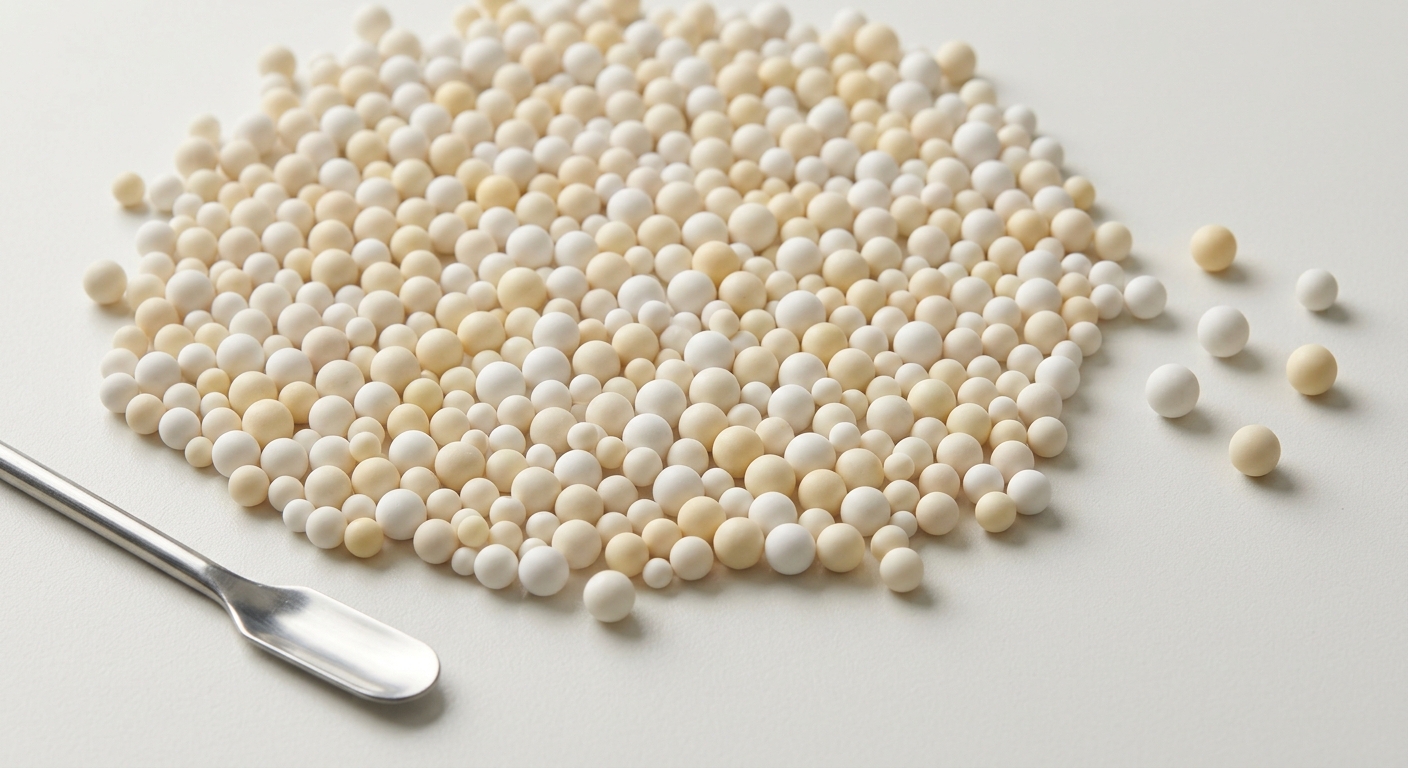

Ceramic beads (grinding media) for bead and ball mills are high-density spherical particles with a uniform microstructure and smooth surface. They are designed for highly efficient fine grinding and dispersion of a wide range of products: from paints, coatings, and printing inks to pharmaceutical and agrochemical formulations. Exceptional wear resistance, high hardness, and minimal grain size variation ensure stable grinding quality, increased equipment productivity, and reduced final product costs.
Ceramic beads are loaded into the grinding chamber of a bead or ball mill together with the product suspension. Thanks to their high density and hardness, the beads generate powerful shear and impact forces as the rotor spins, effectively breaking down agglomerates of pigments and filler particles into individual microparticles and distributing them evenly throughout the volume. The result is a stable, highly homogeneous dispersion with a narrow particle size distribution, achieved with lower time and energy inputs.
| Parameter | Value |
| Material | Zirconium silicate (ZS) / Zirconium oxide stabilized with yttrium, cerium, etc. (Z, ZY, ZY Premium) |
| Color | White, light yellow, or grayish (depending on composition) |
| Density | from ~4.0 g/cm³ (zirconium silicate) to ~6.0 g/cm³ (zirconium oxide) |
| Hardness | 7 – 8+ Mohs (depending on type) |
| Available fractions | from 0.4 mm to 14 mm (exact sizes and tolerances available on request) |
Note: The values stated are typical for each type of ceramic beads. Exact characteristics for a specific grade/batch are provided on request.
The choice of ceramic bead type depends on the required product purity, the viscosity of the medium being processed, and the severity of the mill operating conditions.
Tip: Always follow the recommendations of your mill manufacturer and test the selected bead type on your product. If you are unsure about the optimal type/fraction combination, contact our specialists – we will help you find the right solution.
Ceramic beads are packed in durable 25 kg bags that protect against moisture and mechanical contamination during transport and storage. Big bag packaging is available on request.
Yes, ceramic beads are chemically inert and do not react with metal. However, please note that under high loads, minor metal wear into the product is possible. For processes requiring absolute purity, mills with ceramic or polyurethane linings are preferable.
Service life depends directly on the bead composition. Zirconium oxide beads (Z, ZY) lose mass 80 times slower than glass beads and 11 times slower than zirconium silicate beads. With the correct type and fraction selected, a single charge can last dozens of times longer, significantly reducing operating costs.
It is not recommended. Different densities and hardness will lead to uneven wear and stratification in the mill chamber. The less durable component will degrade rapidly, contaminating the product. For consistent results, use beads of a single type and fraction.
It is recommended to perform a preliminary “run-in” of the beads at idle with water or a weak surfactant solution for several hours. This removes any microscopic surface irregularities and ensures a stable wear regime from the very first product batches.