


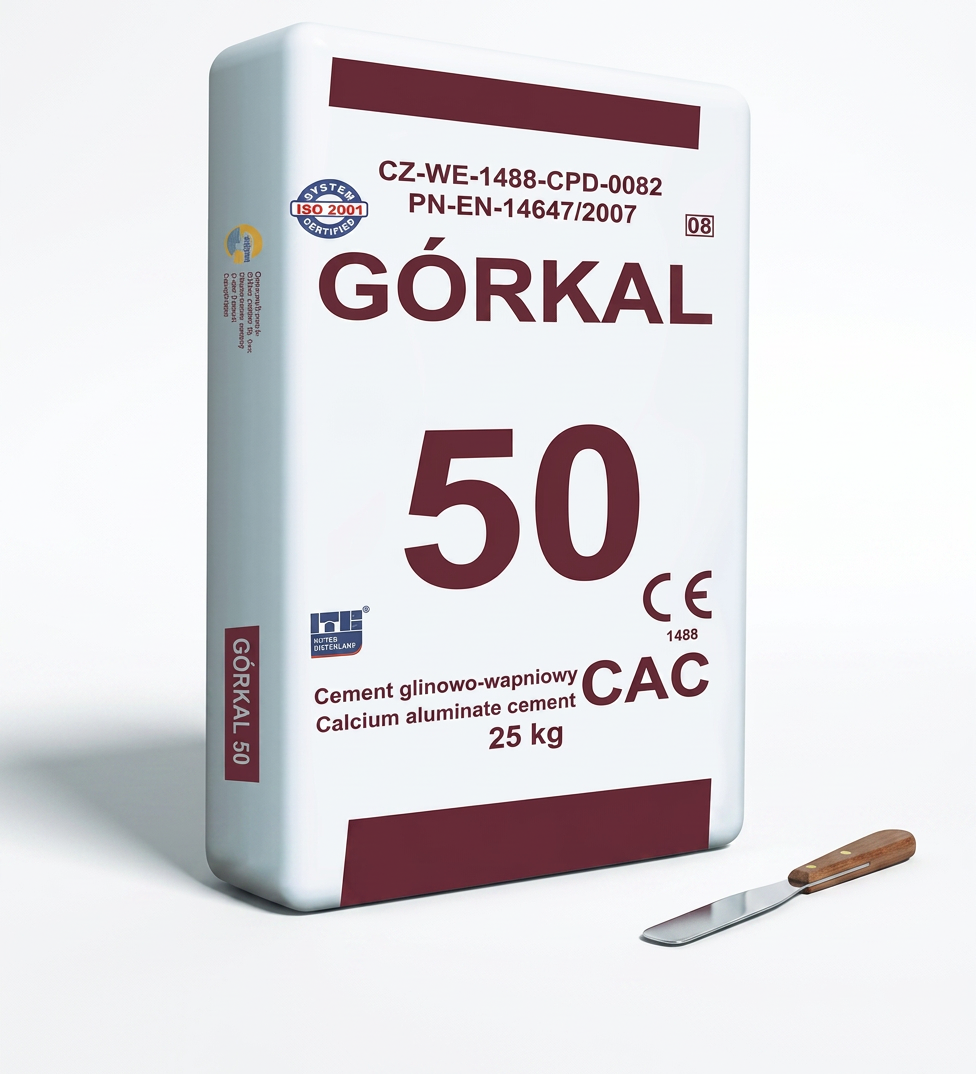

GÓRKAL 50+ is a hydraulic binder for refractory and building applications, manufactured and controlled in accordance with the PN-EN 14647 standard. Its key feature is the low Fe₂O₃ content (below 3%), which provides high purity and property stability at temperatures up to 146 sP (Seger cone). Thanks to a stable phase composition (main phase CA with secondary CA₂), this cement is oriented towards use in insulating refractory mixes, monolithic products, and building chemistry.
| Parameter | Value |
| Chemical composition (typical values) | Al₂O₃ 51–55%, CaO < 38%, SiO₂ < 5%, Fe₂O₃ < 3% |
| Principal mineralogical phase | CA |
| Secondary phases | CA₂, C₄AF, C₁₂A₇, C₂AS |
| Specific surface (Blaine) | 3000–3500 cm²/g |
| Refractoriness | ≥ 146 sP (Seger cone) |
| Density | 3.0 g/cm³ |
| Bulk density | 1.1 g/cm³ |
| Initial setting time | > 220 minutes |
| Final setting time | < 600 minutes |
| Cold crushing strength after 6 h | > 18 MPa |
| Cold crushing strength after 24 h | > 45 MPa |
| Shelf life in dry conditions | up to 12 months from production date |
Note: characteristics determined in accordance with EN-196. Exact values may vary within specification limits.
GÓRKAL 50+ aluminous cement is packed in multi-layer 25/50 kg bags or 1 t big bags, providing protection against moisture. Exact weight and packaging type to be confirmed upon order.
Yes, the cement can be applied down to -10 °C without the need for heating. It releases sufficient heat during hardening to ensure strength development.
Compressive strength exceeds 18 MPa after 6 hours and over 45 MPa after 24 hours. The longer initial setting time (over 220 minutes) facilitates placement of large volumes.
GÓRKAL 50+ contains more alumina (51–55% vs >41%) and significantly less iron oxide (<3% vs ≤16%), giving it higher refractoriness (≥146 sP vs ≥128 sP). It is preferred for insulating refractory mixes and monolithic products, while GÓRKAL 40 is more often used for structural refractories and repair mortars.
When stored in dry conditions, the shelf life is up to 12 months from the production date. Avoid contact with moisture.
Its primary purpose is insulating refractory mixes and lightweight monolithic linings. It also excels in building chemistry where high purity and low iron content are essential.