


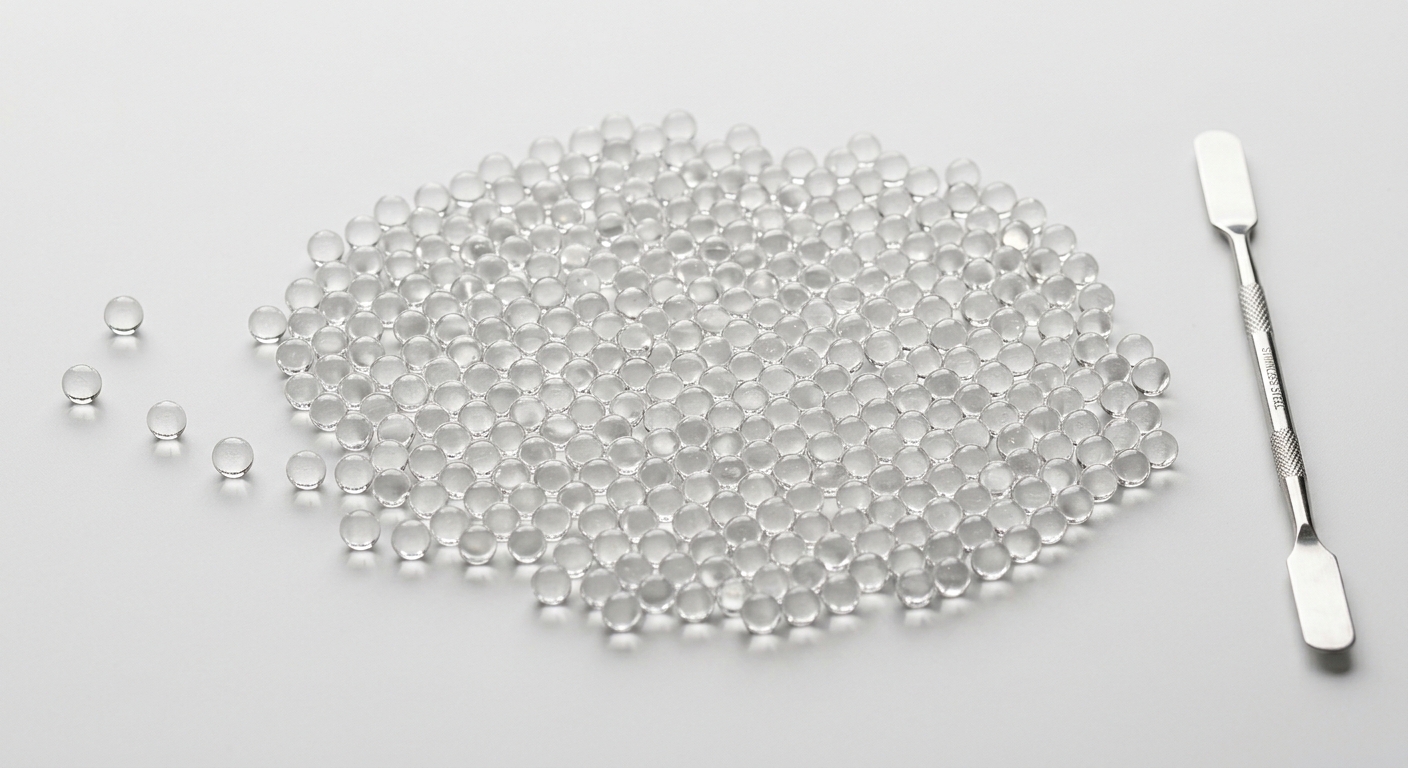

Glass beads (grinding media) for bead mills are high-quality solid spherical particles designed for fine wet grinding and dispersion of pigments, fillers, and chemical products. Near-perfect sphericity, high strength, and the absence of internal defects ensure clean and stable grinding without contamination of the final product. Suitable for all types of vertical and horizontal bead mills.
Glass beads are loaded into the grinding chamber of a bead mill together with the suspension. As the rotor spins, thousands of beads collide intensively, generating shear and impact forces. They break down pigment agglomerates into individual particles and distribute them evenly throughout the volume. The result is a stable, homogeneous dispersion free of lumps and coarse particles.
| Parameter | Value |
| Material | Soda-lime glass |
| Color | Transparent, colorless |
| Specific gravity | 2.4 – 2.6 g/cm³ |
| Hardness | 6 – 7 Mohs |
| Compressive strength | ≈ 1200 N |
| Diameter | Tolerance, mm |
| 0,8 – 1,2 mm | ± 0,2 |
| 1,0 – 1,5 mm | ± 0,2 |
| 1,5 – 2,0 mm | ± 0,2 |
| 2,0 – 2,5 mm | ± 0,3 |
| 2,5 – 3,0 mm | ± 0,3 |
| 3,0 – 4,0 mm | ± 0,5 |
| 4,0 – 5,0 mm | ± 0,5 |
| 5,0 – 6,0 mm | ± 0,5 |
Tip: Always follow the bead size recommendations of your mill manufacturer for your specific product. If you are unsure which fraction is optimal, contact us – we will help you select the right solution based on the mill type and desired grinding fineness.
Glass beads are packed in heavy-duty polyethylene bags with an inner film that protects against moisture and contamination. Net weight per bag: 25 ± 0.2 kg. The precise weight facilitates dosing when loading the mill.
Yes, glass beads are inert and safe for ceramic linings. If the process requires virtually zero media wear in the product, please consult our specialists – we can offer alternative grinding media for such tasks.
The service life of the beads depends on the hardness of the material being ground, paste viscosity, and mill operating conditions. For example, when dispersing titanium dioxide in paints, consumption remains consistently low and predictable. Exact data for your process can be provided upon request – send us your process parameters, and we will make an approximate calculation.
Mixing is not recommended. Beads of different diameters wear unevenly: smaller beads lose their shape faster and become a source of contamination. For consistent results, we recommend using beads of a single fraction.