


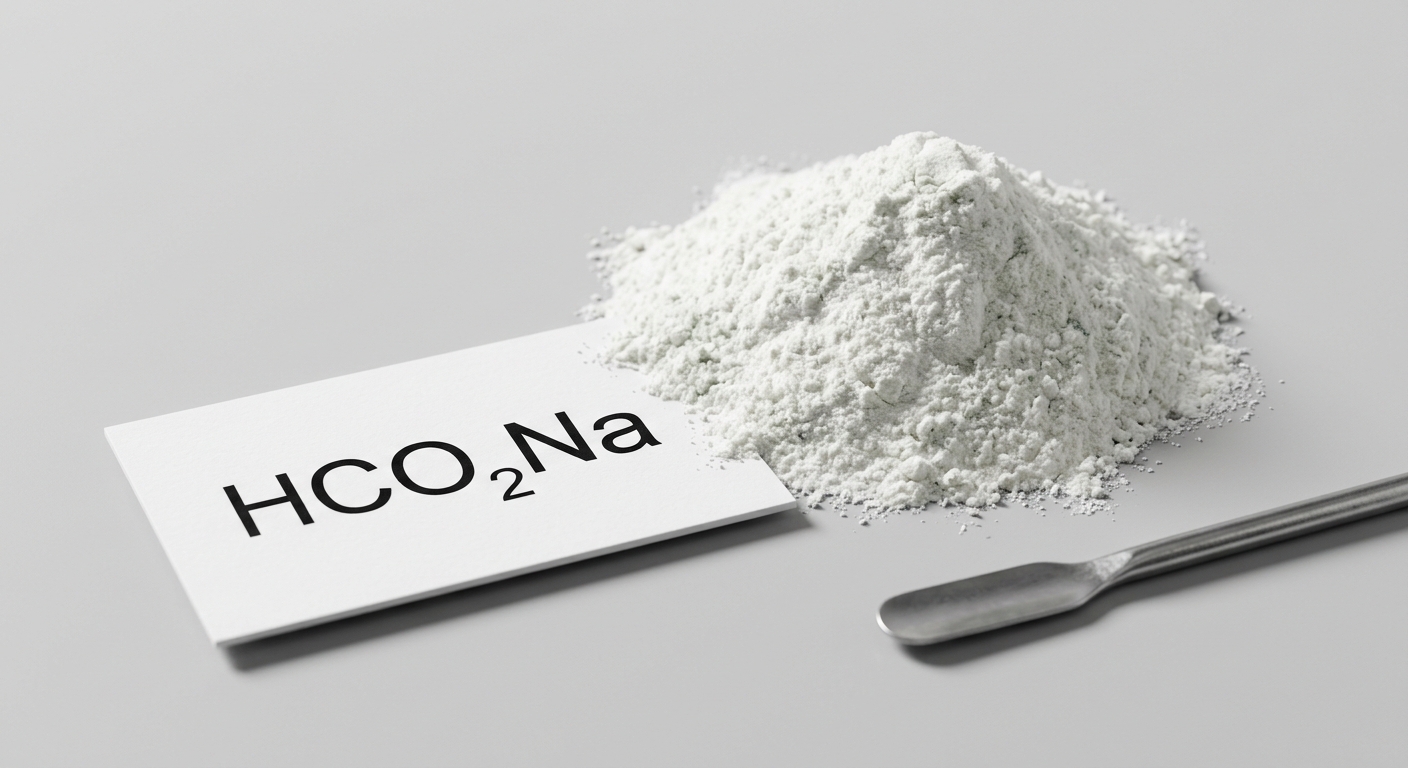

Sodium formate (the sodium salt of formic acid) is a chemical compound obtained as a by-product of the processing of the tetrahydric alcohol pentaerythritol. It appears as a powder, predominantly white (greenish and grey specks are acceptable), free of foreign impurities, with a moisture content of about 3%. Chemical formula: HCO₂Na.
Sodium formate dissolves readily in water, is poorly soluble in alcohol, and insoluble in ethers. The substance is non-flammable, classified as hazard class 4 (low-hazard), and does not harm the environment. Its dust may irritate the mucous membranes of the upper respiratory tract and eyes.
| Parameter | Value |
| Chemical formula | HCO₂Na |
| Appearance | White powder (greenish and grey specks allowed) |
| Moisture content | ~3% |
| Solubility in water | Fast, highly soluble |
| Solubility in alcohol | Poor |
| Solubility in ethers | Insoluble |
| Flammability | Non-flammable |
| Hazard class | 4 (low-hazard substances) |
Sodium formate must first be dissolved in warm water, and the resulting solution introduced into the concrete mix with continuous stirring. This ensures uniform distribution of the admixture throughout the volume and prevents local overdosing that could cause excessively rapid setting.
Sodium formate works excellently together with superplasticizers based on naphthalene sulfonates (e.g., S-3). This combination simultaneously provides high workability of the concrete mix and reliable hardening at sub-zero temperatures, compensating for the weak inherent plasticizing effect of sodium formate.
Concrete containing sodium formate must not be used in prestressed structures, water-retaining and gas structures, buildings of electrified transport, or under dynamic loads on concrete. It is also prohibited in rooms with an expected humidity above 60% unless reliable waterproofing is provided.
The admixture works at temperatures down to -15 °C. Recommended sodium formate content by weight of cement: up to 2% at temperatures down to -5 °C, up to 3% down to -10 °C, up to 4% down to -15 °C. Exceeding these dosages may lead to excessively rapid setting and complicate mix placement.
The substance belongs to hazard class 4 (low-hazard), is non-flammable, and environmentally safe. However, its dust can irritate the mucous membranes of the eyes and upper respiratory tract. Therefore, when handling the dry powder, it is advisable to use protective goggles, a respirator, and gloves. Avoid generating dust and store the product in a dry place in tightly sealed containers.