


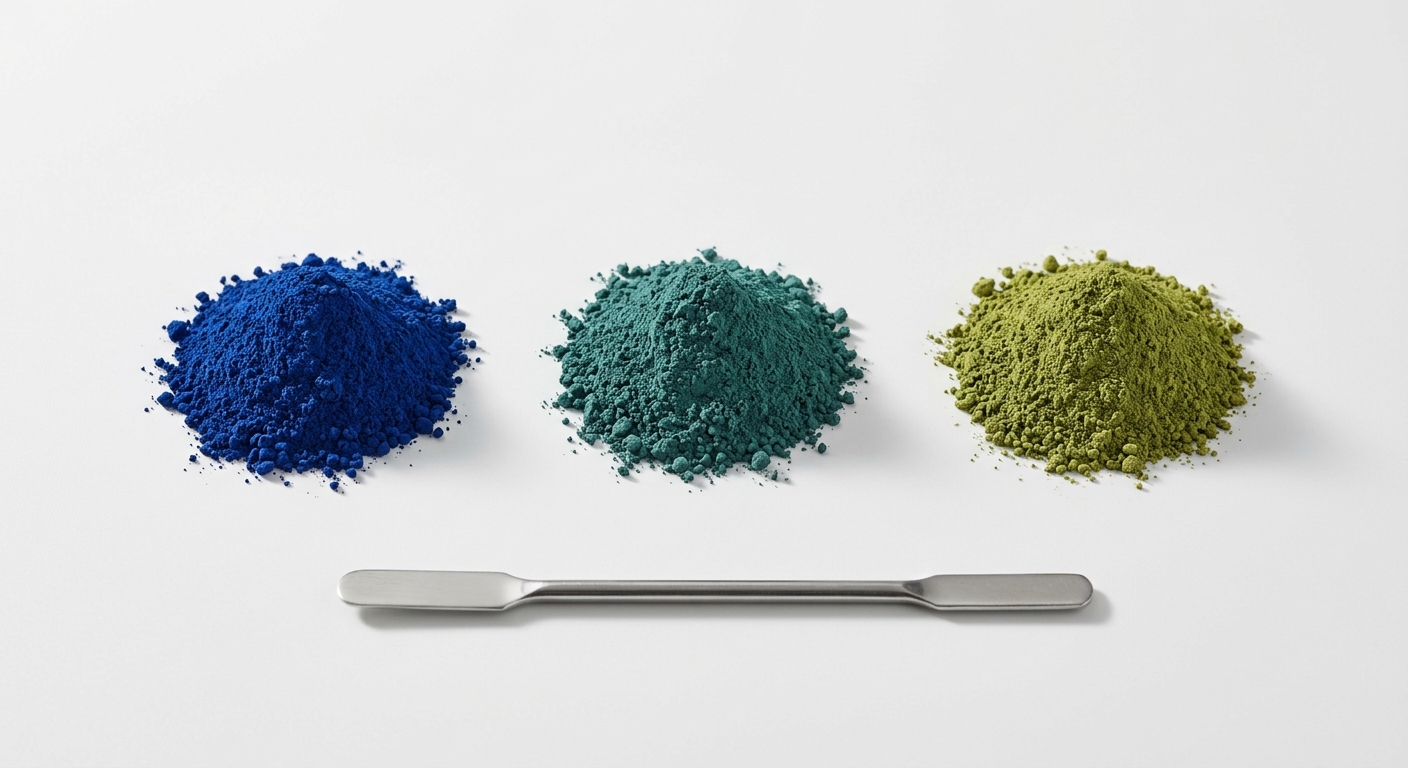

Blue and green phthalocyanine pigments are among the most important organic pigments. Due to their high tinting strength, lightfastness, and weather resistance, they are widely used in the paint and coatings industry.
The blue pigment is a copper complex of tetraaza tetrabenzoporphine. Green 7 is its chlorinated derivative, offering a rich green color. Green 36 is a brominated derivative with a yellowish-green shade.
These pigments are intended for use in paints and provide bright, stable colors resistant to external influences.
Note: the listed advantages are common for high-quality phthalocyanine pigments. Specific values (lightfastness, dispersibility, heat resistance) are provided on request.
| Pigment | Chemical description | Color |
| Pigment Blue | Copper complex of tetraaza tetrabenzoporphine (Cu-phthalocyanine) | Blue |
| Pigment Green 7 | Chlorinated derivative of copper phthalocyanine | Green |
| Pigment Green 36 | Brominated derivative of copper phthalocyanine | Yellowish-green |
Phthalocyanine pigments are intended for use in paint and coating materials: water-based and solvent-based paints, enamels, varnishes, primers. They are applied in architectural, industrial, and decorative coatings where high color retention and durability are essential.
They are intended for use in various paint systems – water-based, alkyd, acrylic, oil-based, and others. Exact compatibility should be confirmed for each grade.
Both are derivatives of copper phthalocyanine. Green 7 is obtained by chlorination and has a rich green color. Green 36 is a brominated derivative with a more yellowish shade. The choice depends on the required coloristics of the coating.
Phthalocyanine pigments are traditionally known for high lightfastness and weather resistance, making them suitable for exterior coatings. The specific level of durability depends on the grade and is confirmed by technical documentation.