


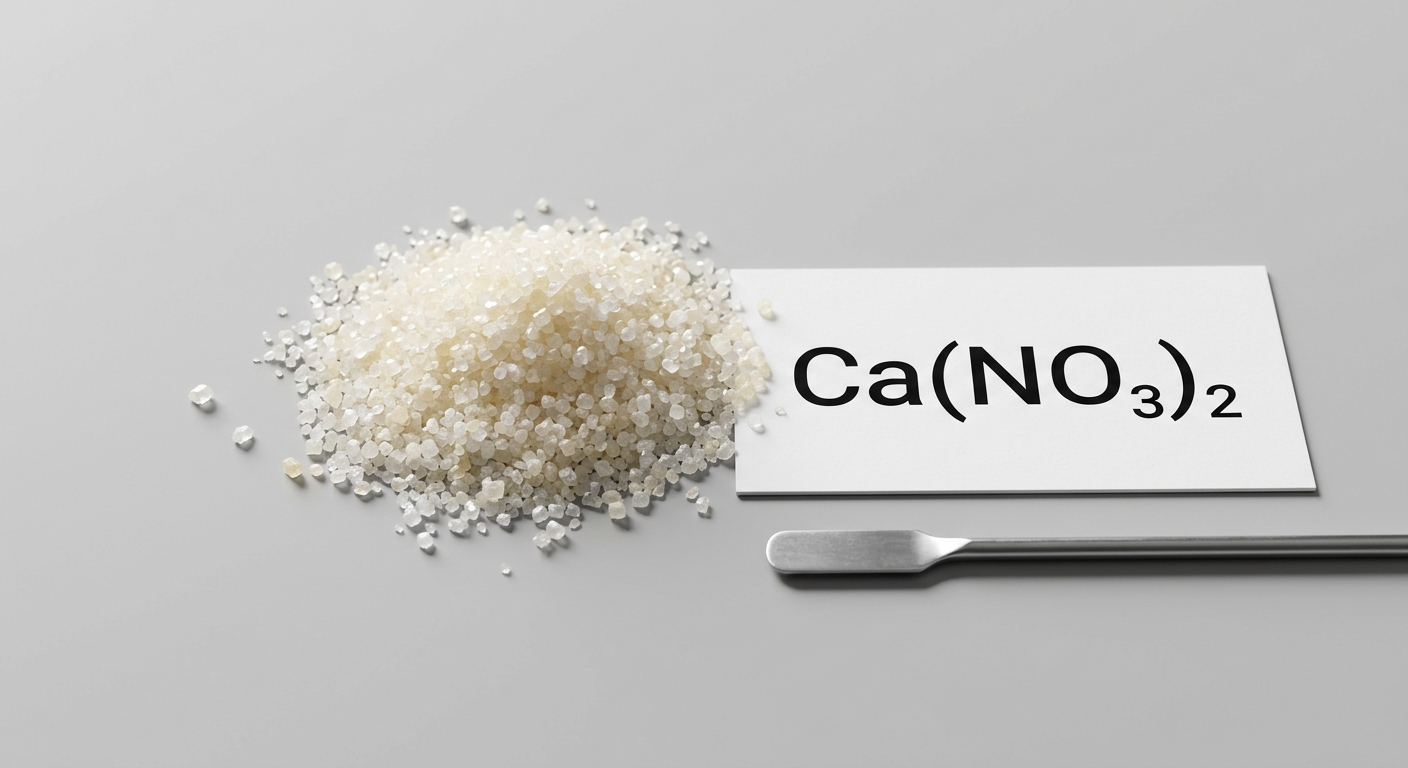

Calcium nitrate (lime saltpeter) is an inorganic salt of nitric acid with the chemical formula Ca(NO₃)₂. It is commercially supplied as a granulated product: white or light-yellow granules, readily soluble in water. Owing to a special granulation process, the material does not cake, produces no dust, and remains free-flowing even after prolonged storage. It acts as a strong oxidizer and is widely used as a source of calcium and nitrate nitrogen in various sectors: from agriculture to construction and oil production.
Calcium nitrate is a strong oxidizer. Avoid contact with combustible materials, oils, and organic substances. It decomposes on heating, releasing toxic nitrogen oxides (NOₓ). When handling, use rubber gloves, protective goggles, and a respirator.
Yes, this is one of its main construction functions. It lowers the freezing point of water and accelerates strength gain of cement paste even at sub-zero temperatures. Unlike chloride-based anti-freeze admixtures, calcium nitrate does not cause reinforcement corrosion.
Calcium nitrate (lime saltpeter) contains calcium and nitrate nitrogen, does not acidify soil, and is recommended for calcium-sensitive crops. Ammonium nitrate contains ammonium nitrogen, acidifies soil more strongly, and provides no calcium.
Calcium nitrate must not be mixed in concentrated form with sulfates (e.g., magnesium or potassium sulfate) and phosphates. This results in insoluble precipitates (gypsum, calcium phosphate) that can clog drip irrigation emitters and reduce nutrient availability. Always consult compatibility charts or prepare stock solutions separately when tank-mixing.
In a dry, cool, well-ventilated area, away from combustibles, acids, alkalis, and heat sources. The container must be tightly sealed. Due to its granulated form, the product is less prone to caking than crystalline types if kept dry.
With standard safety precautions (gloves, goggles, respirator) it is safe to handle. It is not a combustible substance, but as a strong oxidizer it can support the combustion of other materials. On intense heating or in a fire it decomposes, releasing toxic nitrogen oxides (NOₓ). Large quantities of nitrates entering water bodies are undesirable due to the risk of eutrophication.