


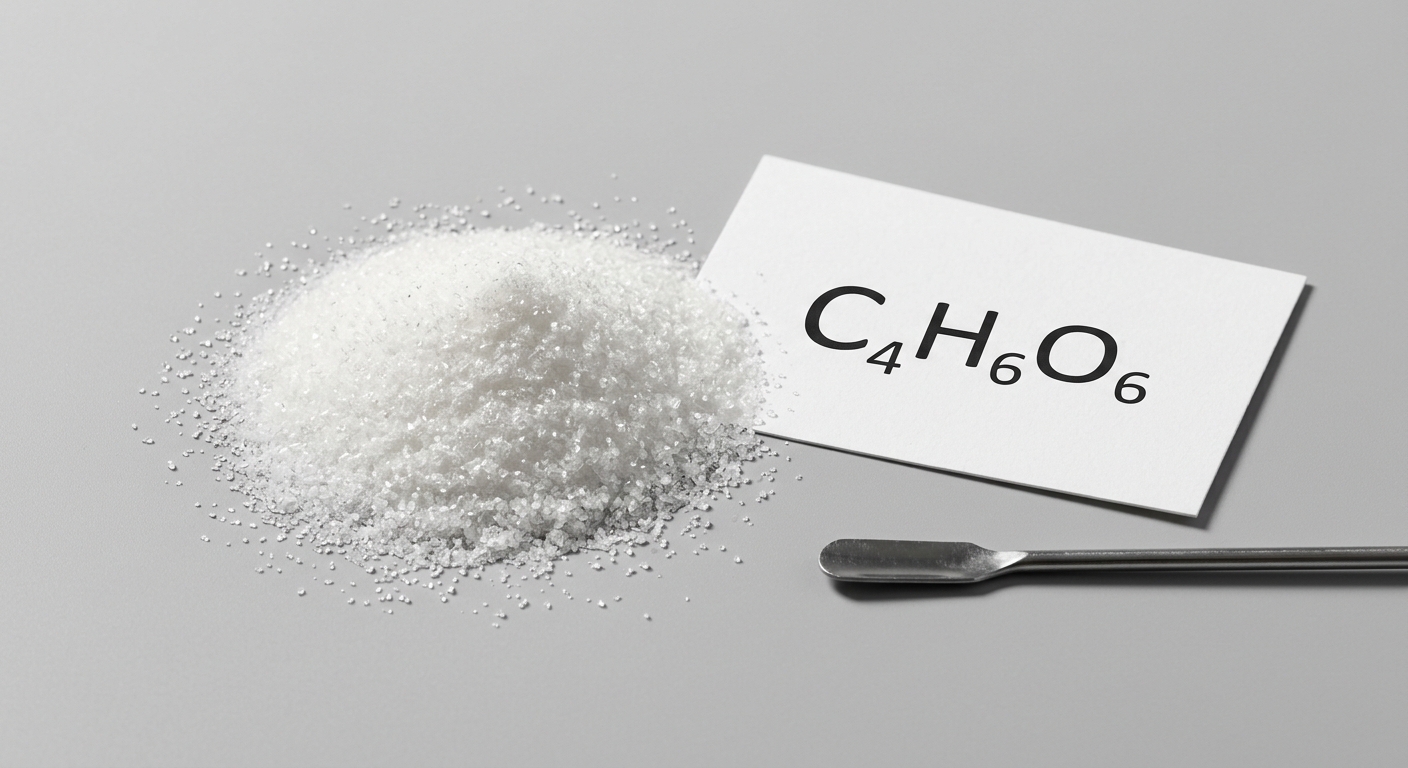

Tartaric acid is an organic dicarboxylic acid of natural origin, first isolated from wine lees (tartar). Chemical formula: C₄H₆O₆. The most commonly used industrial form is L-(+)-tartaric acid (food additive E334). It appears as a white crystalline powder, odorless and highly soluble in water. It has a distinctly sour taste and is used as an acidulant, acidity regulator, antioxidant, and an effective retarder for mineral binders.
When handling powdered tartaric acid, avoid contact with eyes and skin: may cause irritation. Use protective goggles and gloves. Store in a dry, cool place in a tightly closed container. The substance is non-flammable and non-toxic under normal use.
Both are organic acids but have different chemical structures and flavor profiles. Tartaric acid (E334) occurs in grapes, has a sharper, clean sour taste, and is more commonly used in winemaking and as a gypsum retarder. Malic acid (E296) is found in apples, has a milder taste, and is popular in confectionery and beverages.
It binds calcium ions, slowing the hydration of calcium sulfate hemihydrate. This provides additional time (from several minutes to tens of minutes) for forming and pouring complex gypsum products. Unlike citric acid, tartaric acid does not disrupt the crystal lattice of gypsum, preserving the maximum rated strength and hardness of the finished casting.
Yes, additive E334 is fully approved by international food safety authorities (EFSA, JECFA) and the regulations of the Customs Union (TR CU 029/2012). It is easily metabolized by the body and completely safe when standard technological dosages in formulations are observed.
In a dry, cool place, in a tightly sealed container, protected from moisture. Shelf life is virtually unlimited under proper storage conditions.