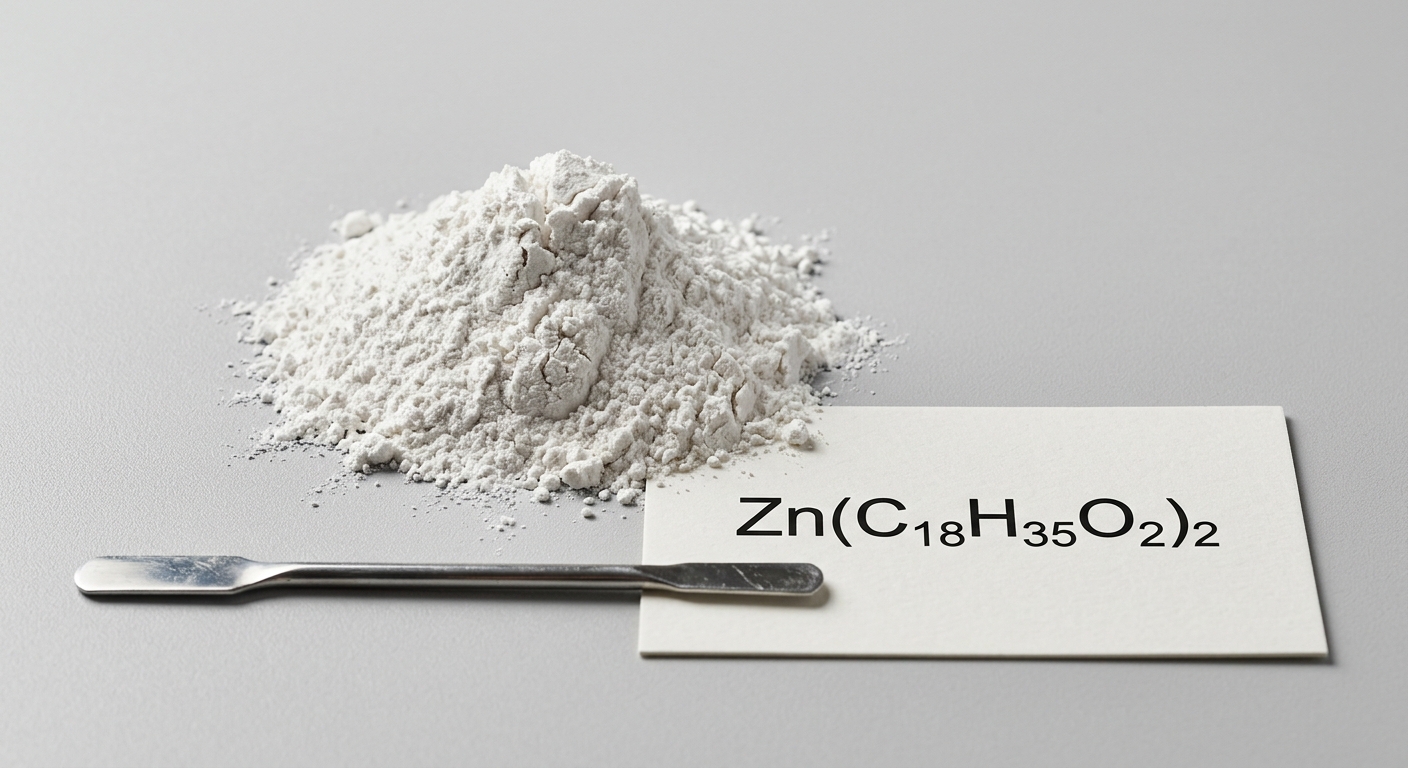
Zinc stearate is a white powder with a characteristic crystalline structure, soft and slightly oily to the touch. It does not cause foaming and does not affect viscosity. Chemical formula: C₃₆H₇₀O₄Zn / Zn(C₁₈H₃₅O₂)₂.
The substance is obtained by reacting stearic acid with zinc hydroxide under heating and vigorous stirring. Zinc stearate is a surfactant widely used as a lubricant, thermal and light stabilizer, water repellent, and anti-blocking agent in various industries.
Advantages
Excellent lubricating and anti-adhesive properties – prevents materials from sticking to equipment and molds, reduces friction during plastic and rubber processing.
Thermal and light stabilization – protects PVC and other polymers from degradation during processing and service, especially in combination with calcium, barium, lead, and cadmium stearates.
Hydrophobicity – imparts water-repellent properties to dry building mixtures and cosmetic powders, improving their adhesion and coverage.
Does not affect foaming or viscosity – can be introduced into formulations without risk of technological deviations.
Wide working dosage range (0.1–5% depending on application) – cost-effective and flexible.
Uniformity and softness – easily dispersible, ensuring even distribution throughout the mass.
Technical Specifications
Parameter
Value
Appearance
Homogeneous powder, slightly oily to the touch, white to yellowish-white
Density
1.1 g/cm³
Melting point
min. 110 °C
Flash point
277 °С
Auto-ignition temperature
420 °C
Solubility in water, ketones, ethers
insoluble
Solubility in benzene, ethanol, toluene, methanol
soluble
Solubility in dilute mineral acids
partially soluble
Flammability
combustible; fine particles in air form explosive mixtures; emits irritating or toxic fumes (including zinc oxide) in a fire
Note: exact values may vary depending on manufacturer and batch. Full technical data provided on request.
Applications
Plastics processing: lubricant for press powders, preventing sticking to rolls and molds; dosage 0.1–1% (up to 1% in some formulations).
PVC compounds: thermal and light stabilizer combined with calcium, lead, barium, cadmium stearates (linoleum, artificial leather, shoe plastics, packaging film).
Rubber industry: vulcanization activator, plasticizer for rubber compounds, anti-blocking lubricant, dusting agent to prevent sticking; dosage 2–5%.
Construction: hydrophobic additive for dry plaster mixes.
Paints and coatings: leveling agent in polyurethane and nitrocellulose varnishes; 2% addition enables light skinning of the finished coating.
Paper industry: auxiliary component for mass uniformity and imparting smoothness to special grades of paper and cardboard.
Powder metallurgy: lubricating and wear-resistant additive.
Ceramic industry: improves mass viscosity and plasticity, imparts product integrity.
Perfume and cosmetics: component of powder products, improves adhesion and covering capacity.
FAQ
Mainly as a lubricant to prevent the melt from sticking to equipment and molds, and as a thermal and light stabilizer to protect the polymer from degradation at high temperatures and UV exposure.
Yes, it is especially recommended for manufacturing transparent rubbers as it does not impair optical properties and simultaneously acts as a vulcanization activator and plasticizer.
It is not toxic itself, but fine particles in the air can form explosive mixtures. When burning, it emits zinc oxide and other irritating gases, so fire safety measures should be observed.
No, it is insoluble in water, ketones, and ethers. It is soluble in benzene, ethanol, toluene, methanol, and partially in dilute mineral acids.