


When calcium stearate appears in a list of ingredients, many people simply skip over the name — it sounds technical, and its benefits seem minimal. In appearance, it is an ordinary powder: white, odorless, free-flowing. But upon closer inspection, it turns out that its role is quite significant.
It is a product of the reaction between stearic acid and calcium. It is non-aggressive, does not dissolve in water, yet behaves excellently in various formulations. It stabilizes mixtures, protects against moisture, prevents substances from sticking together, and makes the mass more workable. All of this allows it to be used in recipes where the result matters — whether in medicinal tablets, finishing compounds, or compact powder.
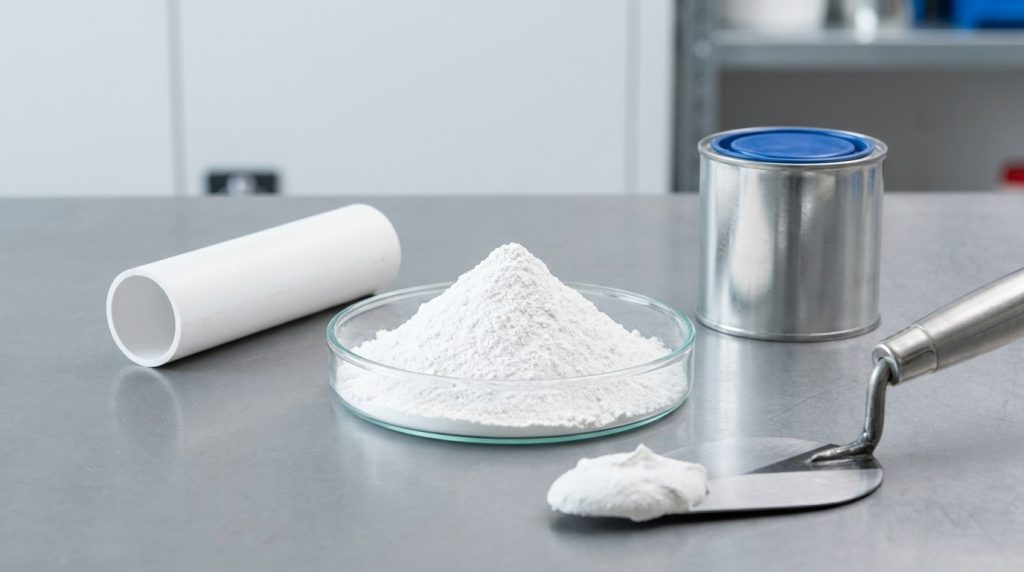
When examining industrial applications, it is easiest to start with plastics processing. Here, calcium stearate performs a rather convenient function — it acts as an internal lubricant within the mass. It is added to polyvinyl chloride, polyethylene, and other thermoplastics so that the raw material does not stick to molds and finished products do not deform during cooling. This is especially important when working with granulated material and thin-walled structures.
In the field of paints and varnishes, the situation is different. In these formulations, the substance helps maintain the homogeneity of the composition. It reduces pigment settling and makes the texture more stable. Such paint applies evenly, does not separate, and retains its properties longer — a logical solution for materials that are stored for several months before use.
As for repair mixes, stearate acts here as a hydrophobic additive. It is included in plasters, sealants, and leveling compounds. It helps reduce water absorption of the finishing surface. This is especially relevant for facade work: moisture and seasonal temperature fluctuations destroy the coating if protective components are not used. Such tasks are a typical area for construction chemistry, where reliability matters from the first layer.
There is an opinion: “calcium stearate is harmful to the body,” and this sometimes surfaces as a concern. But if we look at the issue soberly, most checks show that the substance is safe. It is officially approved for use in pharmaceuticals and cosmetics and is part of products that have passed all stages of sanitary control.
A hazard may arise in the form of dust inhalation — but this applies only to industrial conditions. In household or everyday use, contact is either minimal or entirely absent. When ingested, the compound is not absorbed. It does not enter into reactions and simply exits the body naturally. It is especially important that in medicinal preparations it is used in microdoses, and its physical and chemical inertness plays in its favor — the substance does not interfere with active ingredients.
So if the product is of high quality and used as intended — and this is the basis of any safe production — it poses no threat.
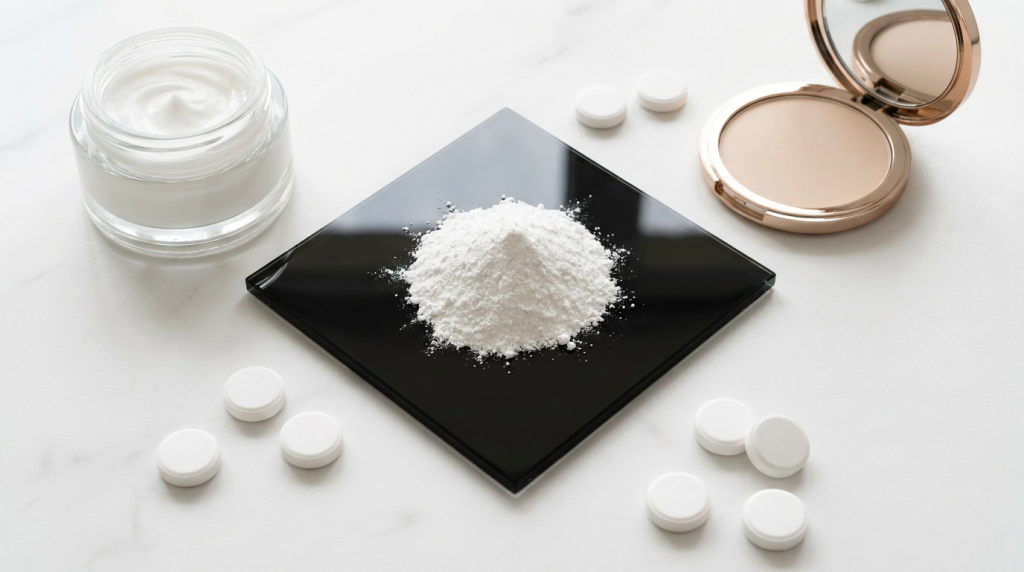
For pharmaceuticals, the compound serves an important technical function. In solid form, it improves powder distribution, ensures the required density, and preserves the shape of the preparation. In tablet production, calcium stearate is used in medicine as an anti-caking agent — thanks to it, tablets do not crumble or stick during compression.
In cosmetics, the substance is found in deodorants, compact powders, and skin care products. It improves texture, makes the composition homogeneous, extends the shelf life of emulsions, and protects against separation during temperature changes. At the same time, it does not affect pH and does not react with oils or active components — multifunctionality is complemented by neutrality.
At first glance, calcium stearate has a simple task — to be an auxiliary component. But it is precisely such “quiet” elements that often determine how stable the main composition will work. In formulations, this component is valued for its flexibility: it combines well with acids, withstands alkaline environments, and does not interfere with dyes. This is important in mixtures where a balance between chemically active and neutral substances must be maintained.
It can be combined with various salts — magnesium, zinc, aluminum. The choice depends on what effect is expected from the formula: improved distribution, light lubrication, or moisture control. In this regard, calcium stearate behaves predictably — it does not “spoil” other components and easily fits even into complex systems.
Sometimes it replaces other metal stearates. The reasons vary: sometimes price is important, sometimes a general reduction in chemical load, especially in products with high environmental requirements. The calcium form performs admirably — in terms of final product quality, the difference is often unnoticeable, while safety and availability are high.
It can be said that its function is invisible but key. In a composition it is barely noticeable, but without it many formulas simply would not work. It is precisely this versatility that makes it sought after — from cosmetics to plastics and pharmaceuticals. It does not stand out — but it solves problems.
Calcium stearate belongs to those substances that rarely arouse interest — but whose absence is immediately felt in production. It does not catch the eye, has no odor, and has no active effect. Nevertheless, it is precisely this substance that helps materials retain their shape, not lose their properties, and withstand loads. The additive is simple in structure but important in effect.
The main advantage of this compound is its versatility. In one situation it protects a construction mix from moisture, in another it makes a tablet strong, and a cream smooth and stable. This ability to “work in the shadows” makes it a reliable choice for a wide variety of industries: from industry to pharmaceuticals.
In compositions, calcium stearate is usually not advertised — it simply does its job. But it is precisely such elements that ensure quality you can rely on. And where stability, compatibility, and practicality are important, it remains relevant, calmly taking its place in basic formulas.