


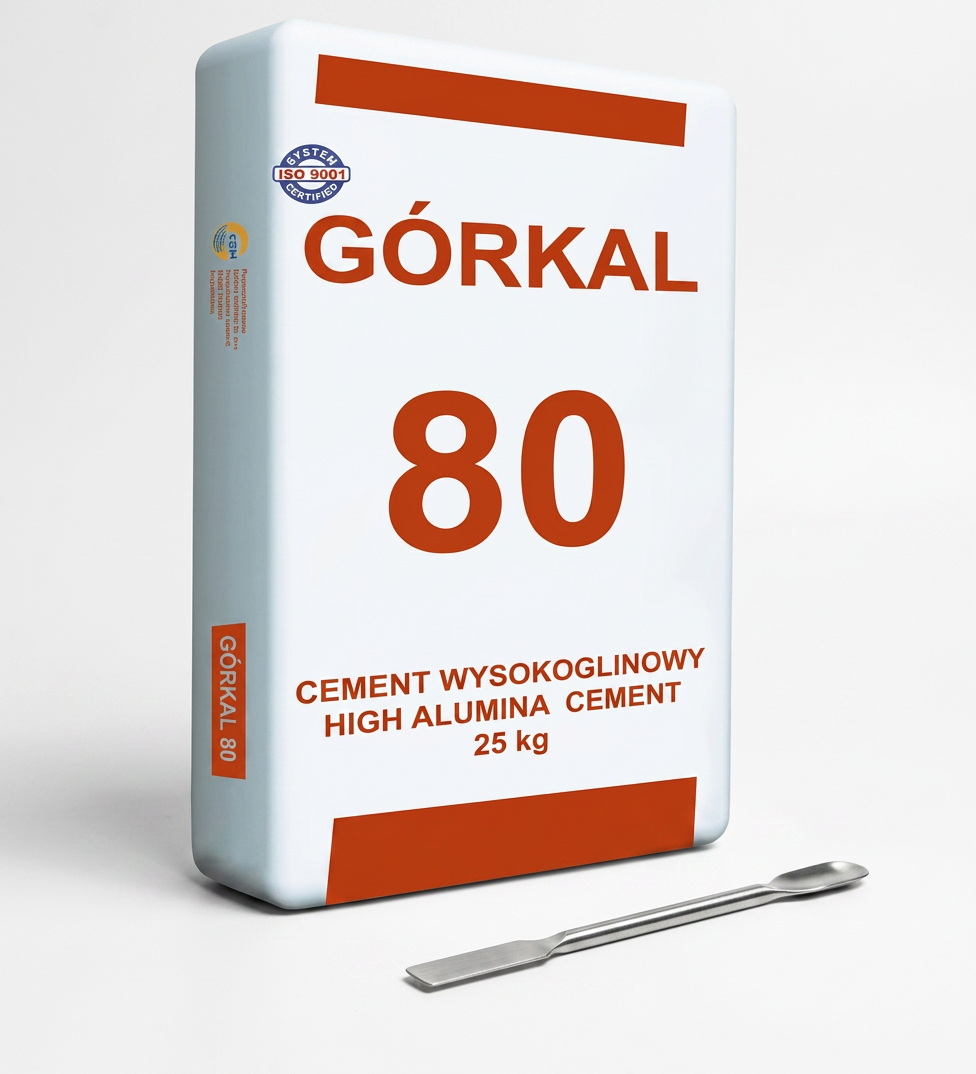

GÓRKAL 80 is a high-alumina hydraulic binder with an Al₂O₃ content of 79–82%, designed to offer maximum refractoriness and satisfactory mechanical properties. It is a chemically pure cement without additives, capable of performing in reducing atmospheres. The product is in the launch phase; manufacturer’s feedback is welcome. Its exceptionally high alumina content and ultra-fine grinding (specific surface >8000 cm²/g) make it a specialized material for the most extreme thermal conditions.
| Parameter | Value |
| Chemical composition (typical values) | Al₂O₃ 79–82%, CaO <20%, SiO₂ <0.4%, Fe₂O₃ <0.2%, Na₂O+K₂O <0.7% |
| Principal mineralogical phase | CA, CA₂, αAl₂O₃ |
| Secondary phases | C₁₂A₇ |
| Specific surface (Blaine) | >8000 cm²/g |
| Refractoriness | >173 sP (Seger cone) |
| Initial setting time | >120 minutes |
| Final setting time | <360 minutes |
| Cold crushing strength after 6 h | >6 MPa |
| Cold crushing strength after 24 h | >20 MPa |
| Shelf life in dry conditions | up to 6 months |
Note: Exact characteristic values may vary within the specification limits.
GÓRKAL 80 aluminous cement is packed in multi-layer 25/50 kg bags or 1 t big bags, providing protection against moisture. Exact weight and packaging type to be confirmed upon order.
GÓRKAL 80 contains even more alumina (79–82% vs 69–71%) and has a significantly higher specific surface (>8000 cm²/g vs 4000–4500 cm²/g). This results in higher refractoriness (>173 sP) and the ability to work in reducing atmospheres where GÓRKAL 70 may not always be suitable.
The ultra-fine grinding (>8000 cm²/g) is designed for maximum reactivity and dense particle packing in the refractory. It improves sintering, reduces porosity, and enhances the strength of the structure after firing, despite the moderate initial strength of the cement stone.
Yes, it is specifically developed for such conditions. Low iron oxide and alkali content prevents the formation of low-melting phases and degradation under CO, H₂, and other reducing gases.
Due to the ultra-high fineness and purity, the cement is more reactive and absorbs moisture from the air faster. If stored in dry conditions, it retains its properties for 6 months, after which it is recommended to check its activity.
Cold crushing strength after 6 hours exceeds 6 MPa, and after 24 hours it is over 20 MPa. These values are sufficient for most refractory structures, especially considering subsequent sintering and strength gain at high temperatures.